

I Gave an LT on Exploring AI and XR at Codex Meetup Tokyo #1
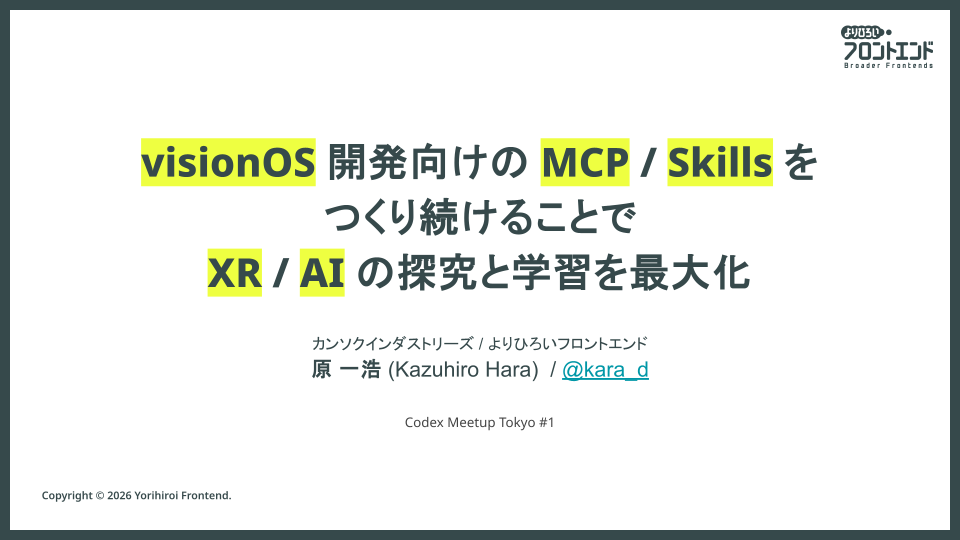
On Thursday, March 19, Codex Meetup Tokyo #1 was held in a space inside the Mercari office at Roppongi Hills. I also gave an LT titled "Maximizing XR Exploration and Learning by Continuing to Build MCP / Skills for visionOS Development." Thank you to everyone who attended. This time I will write about the materials and some supplementary content.
The event consisted of three talks of about 15 minutes each and several lightning talks. The LT order changed around, so I do not remember the exact number. There were many talks, from tips to ways of thinking, and many things I did not know, so as someone who regularly uses OpenAI-related products heavily, it was an enjoyable time. Thank you to all the speakers. There were nearly 400 registered attendees, so even accounting for absences, I think there were more than 300 people. The densely arranged chairs were packed with people. I arrived early, so I ended up sitting in the front row.
At the beginning of Codex Meetup Tokyo #1, there were several show-of-hands surveys. What I found especially interesting was that many people said they use both Codex and Claude Code. I also use Codex and Copilot together, but I had expected AI tools to be more dispersed. Using major, widely used tools is a perfectly reasonable state of affairs, but in the era when programming languages and frameworks were everyone's main interest, tool selection felt more scattered.
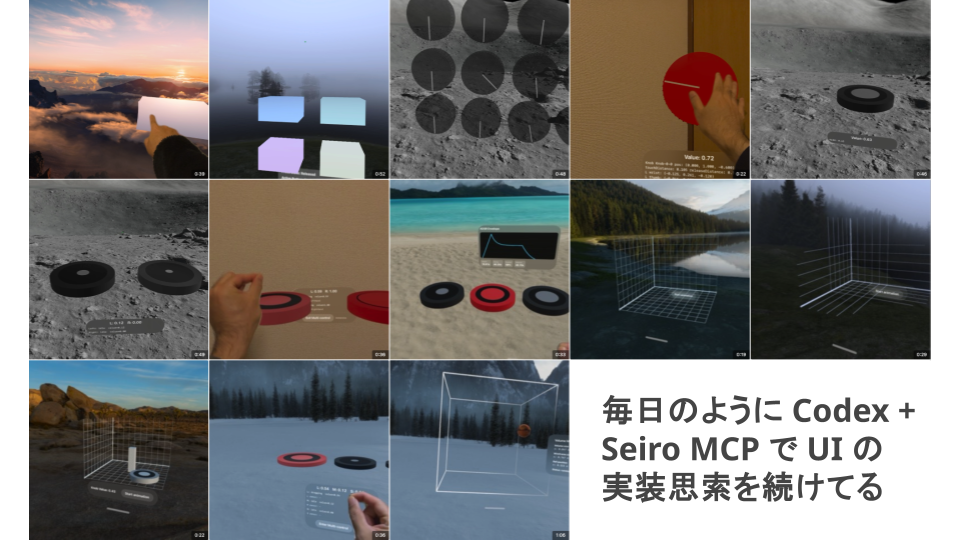
I will write about something related to the LT. Since the beginning of March, I have been doing daily experiments mainly around visionOS UI and posting the results to X. Of course, there are days when things do not go well and I only end up doing maintenance. I am not doing it because I decided I must do it every day. The real reason is that experiments using visionOS and Seiro MCP have gradually started to run smoothly. I plan to write a separate entry about what I actually do, but it took time to develop this style.
I had made various experimental samples before, but they did not progress well. Now I can continue doing it like a diary, and it seems that I have established my own implementation and learning cycle for the AI era.
In the first half of the LT, I talked about how even when a feature you want is completed, that is actually only the beginning and new issues become visible. In the second half, I talked about my own cycle of exploration and learning that became visible by continuing to improve beyond that. The slides are below.
As I also mentioned in the LT, I started touching Swift after the ChatGPT era began. It was around the time I learned Vision Pro would be released. I only started touching the SDK after Vision Pro launched in the United States, so I still cannot write Swift the way I want at all. At the time I wrote it using ChatGPT, but I do not feel like it made things progress that smoothly.
Separately, Rust is a language I have been working on for the past few years. I intended to use Rust for backend and WASM-related purposes. However, as AI-related technology has evolved rapidly since last year, I noticed that Rust is also starting to be used quite a bit in the AI area. That made me much more motivated. But once that happened, many things caught my attention and my learning direction became unfocused.
Maybe I was a little impatient at the time. I think there was also a period when I almost lost my identity. My rhythm had also broken down.
Once I decided to write Seiro MCP in Rust to support development in Swift, a language I was not used to writing, it also led to catching up on Rust. To develop Seiro MCP itself, I inevitably had to catch up on MCP and Skills specifications and the Codex CLI repository itself. Fortunately, Codex CLI itself is also written in Rust, so my learning around AI tools also progressed.
Above all, by properly touching these things, I became less afraid of AI than before. Thanks to that, I was able to regain my own rhythm. By using Seiro MCP to create an autonomous loop of development, build, and error capture, even I became able to create samples almost every day.
When you make things every day, you start encountering many unexpected build errors. Those are stacked into the backlog as problems to solve in Seiro MCP, so I research various things to solve them, deepening my understanding of Xcode projects in the process. In other words, tool building and the struggle of output each accelerate the other's learning, and that feels very good.
That was the kind of LT I gave. Since it was only five minutes, I think there were parts where I did not explain enough, but I hope that even one person in the room found some inspiration for their own style in this era.
Also, if you are an individual, company, organization, or event organizer who wants to hear a more detailed talk, I can also talk remotely if you are far away, so please feel free to DM me.